
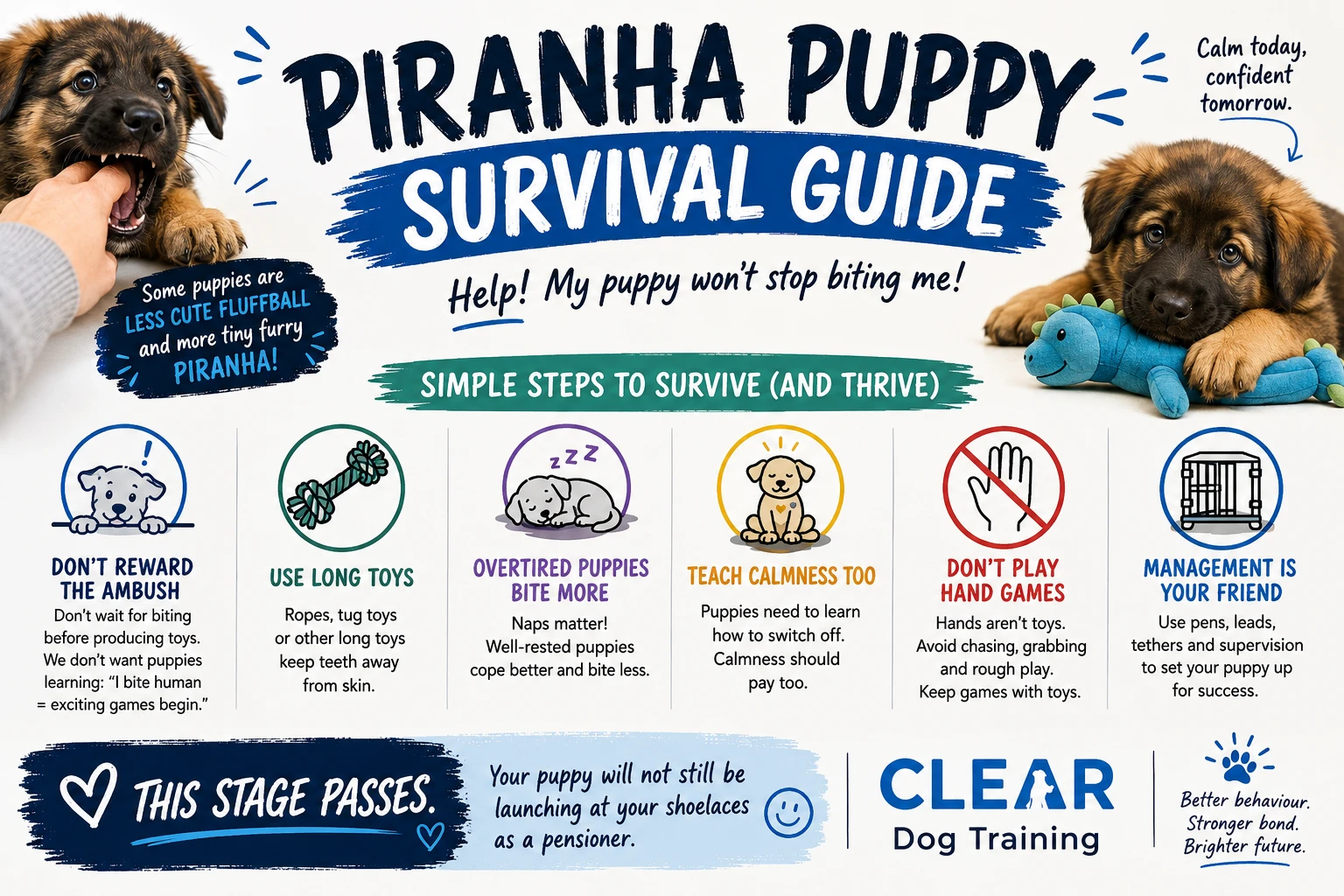
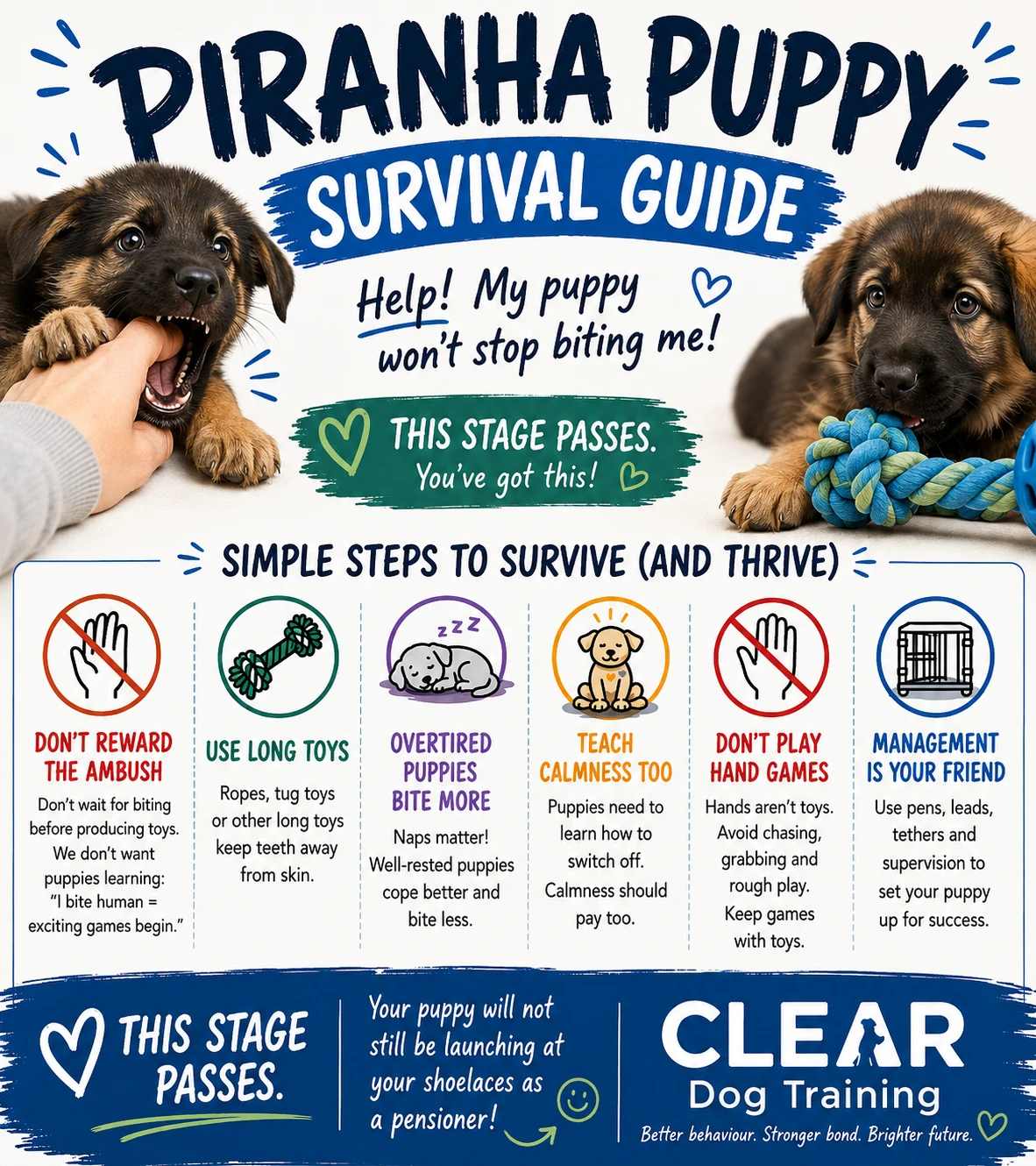
“I feel like I’ve adopted a piranha!” If that sounds familiar, you are far from alone. Puppy biting is one of the most common issues raised by new owners — and while it is usually a completely normal stage of puppy development, that does not make it enjoyable. At CLEAR Dog Training, we often meet overwhelmed owners convinced they have adopted a tiny land shark instead of a puppy. Puppies explore the world with their mouths — grabbing, chewing and play-biting as part of normal development. But nor should you spend the next six months being turned into a human chew toy.
Watch your puppy’s “modes”
Most puppies have times of day where they are far more likely to become bitey and over-aroused.
At CLEAR Dog Training, we sometimes describe them as:
– cocktail-by-the-pool mode
– ballistic-missile mode
If your puppy is in full ballistic-missile mode, that is probably not the moment for quiet cuddles on the lounge. Instead, think proactively. Use structured games, appropriate chew toys, short training sessions or calm management before the biting starts. And remember: overtired puppies often bite more, not less. Naps matter.
Use toys properly
One of the biggest mistakes we see is owners waiting until the puppy bites them and then suddenly producing a toy. Yes, we absolutely want puppies chewing toys instead of humans. But we do not want the puppy learning: “I bite my owner and exciting games magically begin.” Even very young puppies can make that connection. Instead, start appropriate play before the puppy launches onto your hands, clothing or ankles. Longer toys, tug ropes and toys moved along the ground can work especially well because they keep puppy teeth further away from human skin.
Teach calmness, not just activity
Many owners focus heavily on tiring puppies out. Exercise matters — but some puppies actually become more frantic the more overstimulated they become. Puppies need to learn how to switch off too. At CLEAR Dog Training, we often use a very simple settle exercise. We sit quietly with the puppy on lead beside us, with a foot gently resting partway up the lead so the puppy cannot endlessly wander, leap or rehearse biting behaviour. Then we simply wait for softer behaviour. The moment the puppy settles, softens or relaxes, calmness gets rewarded. One useful setup is looping the lead around a sturdy object and back to the handler’s hand. That way, the puppy cannot constantly launch onto you, while still allowing the lead to be released quickly if needed.
Don’t play hand games
Some people think it is funny to encourage puppies to chase fingers and hands. But hand games can accidentally teach puppies that human skin is part of play. Similarly, sitting on the floor at puppy level can sometimes trigger rough puppy-on-puppy style behaviour. If your puppy gets overexcited easily, think about how you are interacting as well as what the puppy is doing.
Teach bite inhibition, not just “no biting”
One important point often gets missed in puppy training discussions: Young puppies actually need opportunities to learn bite inhibition. That means learning how to use their mouths softly and safely. When puppies play with littermates, puppies who bite too hard often get immediate feedback — the other puppy squeals or stops playing. We can teach in a similar way. If your puppy grabs your skin too hard, calmly give brief feedback (“ow” or “too hard”) and immediately stop the interaction for a few moments. Stand up, fold your arms or quietly walk away. Some puppies respond well to a mild “ow”. Others actually become more excited by high-pitched squealing, so keep your response calm and low-key rather than dramatic. The goal is not punishment. The goal is helping the puppy learn: “Hard bites make the fun stop.” As your puppy matures, we gradually raise the bar and expect gentler and gentler behaviour, until eventually teeth on human skin are no longer acceptable.But in the early stages, the priority is often teaching softer mouths first — not expecting perfection overnight.
Practice collar grabs
Puppies also need to learn that hands approaching their face and collar are safe and positive.
One simple exercise is to:
– offer a treat at the puppy’s nose level
– gently touch the side of the collar or neck with the other hand
– then calmly release
Avoid swooping down over the puppy like a bird of prey. The goal is to build trust, not suspicion.
Management matters
Good puppy raising is often about being proactive rather than reactive. Give puppies plenty of appropriate things to chew. Remove things they should not chew. Use pens, leads, crates and supervision wisely. And finally, remember this: For most puppies, the piranha puppy stage does pass. Most puppies improve enormously with maturity, consistency and sensible management. Your puppy will not still be launching at your shoelaces as a pensioner. Until then, management is your friend. And shoes without laces are not the worst idea either.